
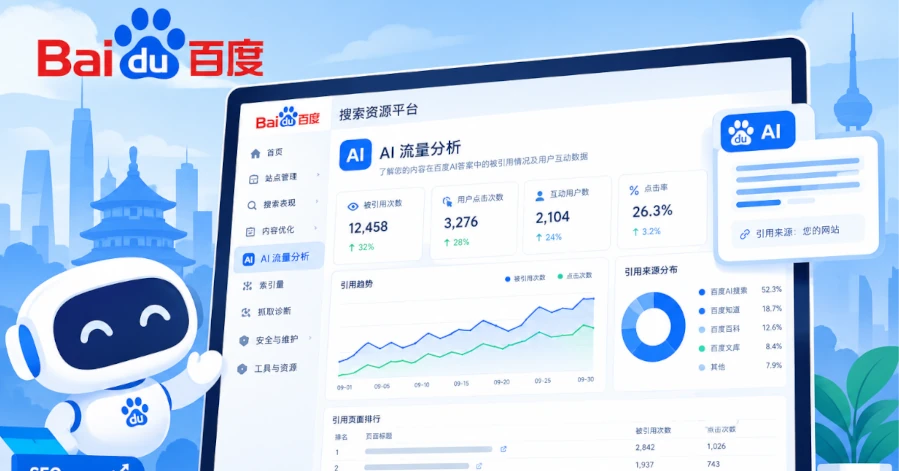

Here is a fuller recap of what Chinese webmaster circles have been chewing on since Baidu put AI Traffic Analysis on the Search Resource Platform — a story we already flagged when the menu appeared, now with more practitioner noise around how to use it. First-party AI visibility metrics in China matter because third-party “GEO tools” have been guessing with scrapers; Baidu finally labelled the surface.
What people are talking about
- Baidu Search Resource Platform now lists AI Traffic Analysis as a first-level item beside classic crawl and traffic tools. That placement alone is the signal: Baidu wants AI citations treated like a product surface, not a side project.
- Chinese write-ups (for example Zhujiba and IPIPP) walk through citations, impressions, clicks, CTR, trend charts, and top keyword/page tables. Practitioners are already framing this as GEO instrumentation, not just another Search Console clone.
- Alongside AI Traffic Analysis, webmasters are also poking at Baidu’s new “search mini-tools” submission flow — toolised site features that can be called from search, with their own dashboards.
What to watch
Data is still rolling out in phases; many dashboards started empty. Several Chinese posts treat early zeros as normal and urge baseline capture the day numbers appear. Also note the metric quirks already debated in English coverage on Search Engine Journal: Baidu’s AI CTR is clicks÷citations, not clicks÷impressions — so calculate both. A high AI CTR can mean rare but compelling citations; a low one can mean you are cited often but users stay in the answer.
Forum energy is less “Baidu killed SEO” and more “finally a first-party AI visibility number in China”. Sensible. Doubao, DeepSeek, and Qwen still will not show up in this report — so do not let a Baidu AI dashboard become your only China AI KPI. Compare with Yandex (heavy consumer AI-SERP, thinner webmaster AI reporting) and Google (AI Overviews drama, still-evolving Search Console signals): Baidu is unusually explicit about naming citations as a product metric.
Practical checklist: screenshot empty states for the audit trail; export weekly once numbers appear; separate classic organic CTR from AI CTR in client decks; and keep mini-tools experiments in a sandbox until Baidu’s submission rules stabilise.
International China teams should also align taxonomy. Map Baidu AI citations to the same content IDs you use for classic organic landing pages, or you will never see which URL shapes win both games. Several agencies are already prototyping “citation share” next to “organic share” in China decks — early, imperfect, and still better than vibes.
Do not forget the negative space. Competitors may show AI citations while your classic organic holds steady — a quiet share shift. Conversely, a citation without clicks might still influence branded search later. Until Baidu documents assisted effects, keep narratives modest and data collection greedy.
When mini-tools submission opens wider, sandbox one low-risk tool before committing core site UX to Baidu’s new surface.