



China’s mobile browsing market is unique, with multiple browsers catering to different user preferences and regulatory restrictions. Websites that fail to optimize for these browsers risk slow load times, poor user experience, and lower visibility on Chinese search engines.
Top Mobile Browsers in China
- Chrome
- Edge / Safari
- UC Browser
- 360 Safe
- QQ Browser
Several browsers dominate China’s mobile landscape, each with distinct features and compatibility requirements. According to Statista, the five most popular mobile browsers are Chrome with a 46% market share, followed by Edge and Safari, each holding around 15%. UC Browser accounts for 8%, while 360 Safe and QQ Browser both have about 6%.
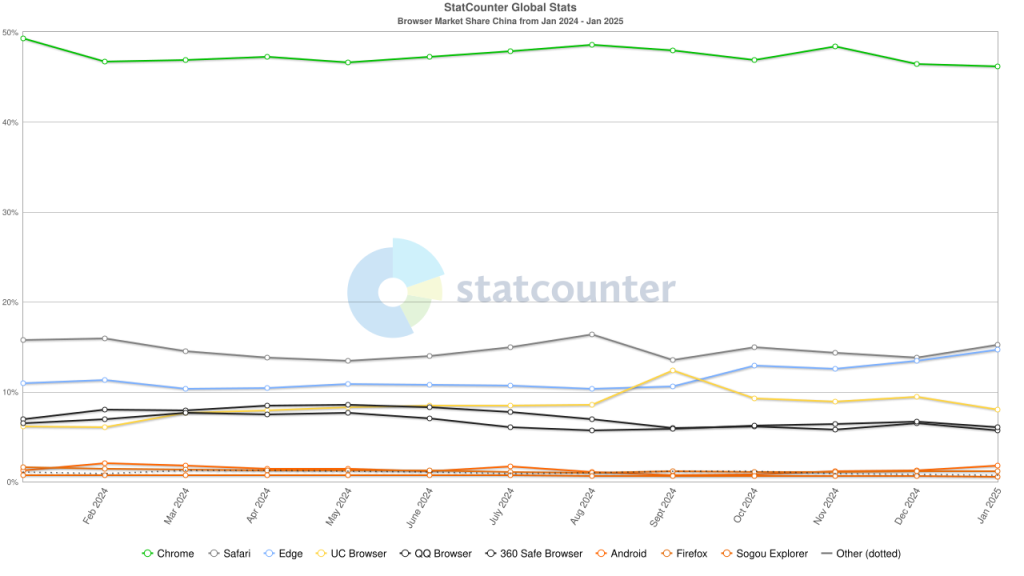
Chrome leads the market but faces challenges in China.
Since Google services are blocked, users must rely on alternative search engines like Baidu, Shenma, or Sogou. Chrome also lacks some browsing habits preferred by Chinese users, such as keeping a page open when clicking on a link. Additionally, websites that rely on Google resources, such as Analytics or AdWords, often experience slower load times.
Edge and Safari each account for around 15% of the market.
Safari’s popularity is tied to the increasing adoption of iPhones in China. However, like Chrome, Safari can face compatibility issues due to the country’s restrictions on foreign elements like Google and Facebook resources. Websites that do not async-load external elements may experience loading delays or timeouts.
UC Browser, with an 8% share, is one of the most compatible browsers in China.
Developed by Alibaba subsidiary UC Web, it is known for its customizable interface, strong widget support, and efficient data compression. UC Browser is also fully compliant with Chinese internet security regulations, making it a reliable choice for users in China.
360 Safe and QQ Browser each hold about 6% of the market.
QQ Browser, developed by Tencent, offers seamless integration with various web apps and includes features like night mode, multi-window management, and a built-in download manager. However, it has faced security concerns in the past.
360 Safe Browser is designed with security in mind, making it a preferred choice for users concerned about data protection.
The Cost of an Unoptimized Website
Websites that are not optimized for Chinese browsers and infrastructure often experience slow performance. One major issue is limited peering. China’s three major telecom providers—China Telecom, China Mobile, and China Unicom—control 95% of internet traffic.
These providers are reluctant to open their networks to external competition, which limits the number of Internet Exchange Points (IXPs) and keeps peering costs high. As a result, website speeds remain slow, especially for international sites.
The Great Firewall of China is another challenge.
This system conducts deep packet inspection, which can block or slow foreign resources, causing delays in website loading times.
If a blocked resource is essential to a website’s functionality, it may lead to significant performance issues. Google-based elements, such as Analytics, Fonts, and APIs, are particularly affected by these restrictions.
Many Chinese browsers also have unique technical requirements, making manual optimization necessary. Scripts, API calls, and other elements may need modifications to function properly.
Additionally, resources like Facebook, Twitter, YouTube, and other Western social media platforms are blocked, impacting websites that depend on them.
For example, Shopify-based sites, which rely on Google services, load nearly ten times slower in China than in other regions. Without proper optimization, some website resources may fail to load entirely, leading to missing fonts or incomplete pages.
Manual Testing for Optimization
Website performance is crucial in China. Studies show that 47% of users expect web pages to load in two seconds or less, and around 40% will leave a website if it takes more than three seconds. A delay of just one second can reduce conversion rates by 7%.
However, many international websites that are not optimized for China take five seconds or more to load, putting them at a significant disadvantage.
Automated tools and VPN-based testing do not always provide accurate insights into real-world performance. The Great Firewall’s impact can vary by region, leading to blind spots in automated testing. VPNs often distort results by affecting network speeds, making it difficult to measure actual performance.
Given China’s vast geography, different regions can experience vastly different internet speeds, further complicating testing. Synthetic testing tools only provide lab-based results and fail to capture the real user experience.
