

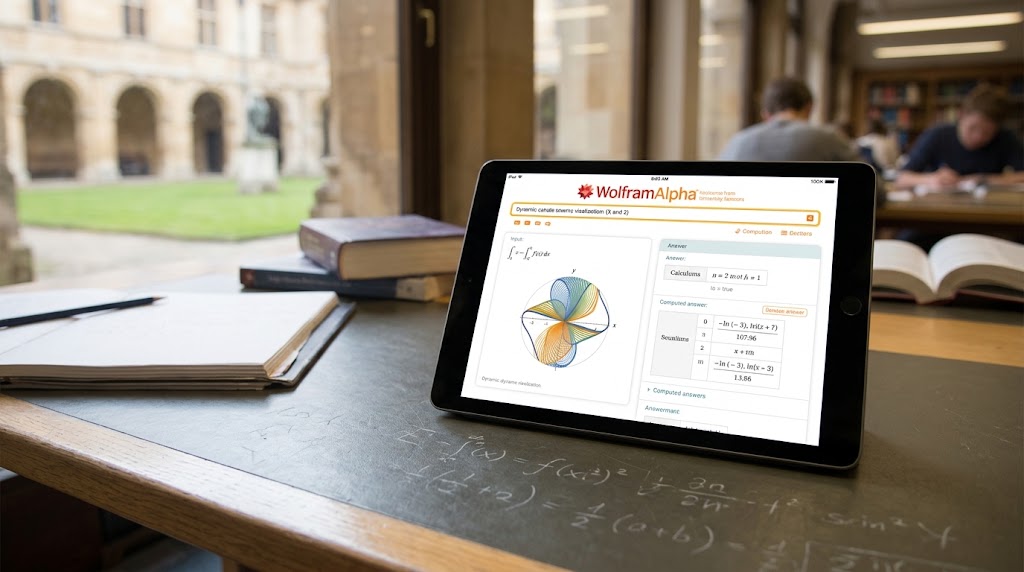

Stephen Wolfram’s 28 September 2026 essay on pure mathematics in the age of AI is long, opinionated and unusually useful for people who sell “AI search” for a living. The through-line: headlines about AIs solving named math problems keep misunderstanding what pure math is. Automating integrals did not kill mathematics when Mathematica shipped in 1988; it raised the level of what humans could ask. Likewise, LLMs that mine millions of papers are powerful thematic search engines over human mathematical culture — not replacements for the human act of choosing which questions are worth asking.
Wolfram draws a sharp line between modern AI and open-ended computation. AI, in his framing, mostly leverages the existing corpus. Computation — especially under computational irreducibility — can generate truly new results by running rules with no shortcut. Those results may be “alien”: true, surprising, and disconnected from human-level narrative. Pure math as humans practise it lives in pockets of reducibility where concepts (sheaves, Lie groups, Clifford algebras) let finite minds tell stories. An AI that dumps axiomatic proofs without human-level anchors fails the actual goal even when a proof assistant says “verified.”
The product hook for our beat is explicit. Wolfram Language is being extended as a high-level language for pure-math constructs so that autoformalisation has a readable target humans and AIs can both check — not only a verbose Lean-style encoding nobody can audit by eye. He also plugs Wolfram MCP connectivity so chatbots can call reliable computation instead of hallucinating symbolic steps. That is the Wolfram|Alpha thesis restated for 2026 agent stacks: search-like interfaces need a computational ground truth layer, not only retrieval plus vibe.
Why ReadIsi readers should care even if they never prove a theorem. Every “AI overview” product is making the same category error Wolfram attacks when it treats answer text as the whole of knowledge work. Evidence fitness, citation dashboards and agent harnesses only matter if someone chose the right question and can verify the formalised claim. Wolfram’s warning about AI-generated documents that have the “statistical texture” of math papers but low probability of being correct maps cleanly onto SEO spam and GEO sludge: fluent ≠ true.
Opinionated takeaways for search product people: (1) invest in verifiable computation beside LLM summarisation; (2) judge AI math / AI search demos by whether they expose checkable intermediate representations; (3) stop selling “the model solved it” when the unsolved problem is question selection. Wolfram is also clear that aesthetic and social consensus still govern which new concepts enter the mathematical lexicon — a useful antidote to “just train bigger” roadmaps.
Bottom line: this essay is soft news for Wolfram|Alpha positioning and hard news for anyone building agentic search. The competitive edge is not another proof farm. It is a language and workflow where humans still set goals, AIs propose, and computation verifies. If your search product cannot show its working in a form a sceptical expert can read, you are shipping statistical texture — and Wolfram just explained why that will keep failing the moment the stakes get real.