



Baidu Ernie, officially known as Ernie (Enhanced Representation through Knowledge Integration), is a large-scale AI language model developed by Baidu, a leading Chinese technology company.
Ernie is similar to models like OpenAI’s GPT and Google’s BERT but is specifically designed to excel in tasks involving the Chinese language, though it also supports multilingual applications.
Key Features
Knowledge Integration
Ernie is designed to integrate structured and unstructured knowledge, which allows it to perform better in tasks that require understanding and reasoning over complex information. This makes it particularly powerful for applications in natural language processing (NLP), such as text classification, question answering, and sentiment analysis.
Generative Abilities
Like other large language models, Ernie is capable of generating human-like text. This makes it useful for tasks such as content creation, dialogue generation, and translation.
Domain-Specific Applications
Baidu has developed various versions of Ernie that are tailored for specific industries, such as finance, healthcare, and education. These specialized models leverage domain-specific knowledge to provide more accurate and relevant results.
Baidu’s AI Search Integration
Its integration into the search engine has significantly improved the quality, relevance, and understanding of search results, particularly for queries in the Chinese language.
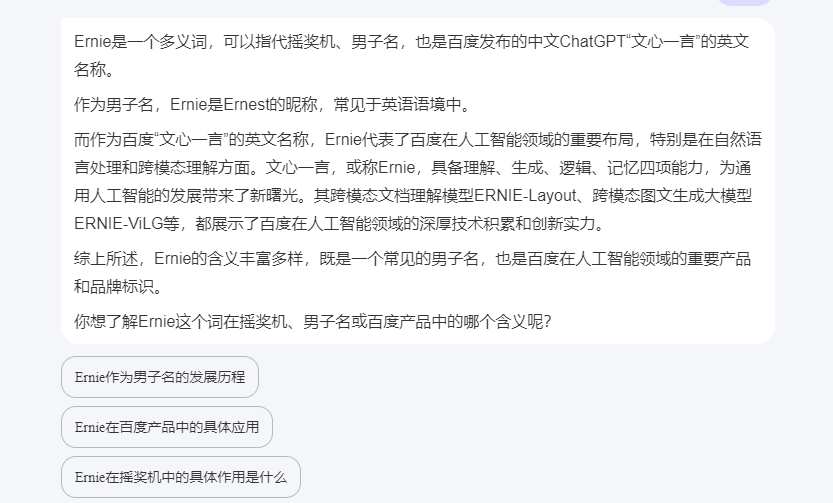
One of the primary ways Ernie contributes to Baidu’s search capabilities is through its advanced natural language understanding (NLU). This allows the search engine to grasp the nuances and intent behind user queries, even when they are complex, conversational, or ambiguous.
By analyzing the context in which words and phrases are used, Ernie can interpret queries more accurately. This contextual understanding is especially valuable in Chinese, where the meaning of words can shift based on their context.
Ernie’s influence extends to the ranking algorithms that determine which pages appear in search results. By enabling a deeper understanding of webpage content, Ernie helps match it more effectively with user queries, ensuring that the most relevant pages are ranked higher.
This move from simple keyword matching to semantic search, where the meaning behind a query is considered, allows Baidu to deliver results that are more closely aligned with what the user is looking for, even if those results do not contain the exact keywords used in the search.
In addition to improving how search results are ranked, Ernie also enhances the presentation of information directly on the search results page. For certain queries, Baidu uses Ernie to generate featured snippets—concise, informative answers that appear at the top of the search results.
By summarizing content from multiple sources, Ernie provides users with clear and accurate responses without requiring them to click through multiple pages. This capability is part of Baidu’s broader effort to make the search experience more user-friendly and efficient.
Another area where Ernie makes a significant impact is in the personalization of search results. By analyzing a user’s search history and behavior, Ernie can better predict their intent, which allows Baidu to tailor search results to individual users.
This personalization leads to a more customized search experience, where users are shown content that aligns closely with their interests and needs.
Ernie’s capabilities are not limited to text-based search. It is also applied in Baidu’s image and video search functions, where it helps in understanding and indexing visual content. By analyzing the associated text and metadata, Ernie improves the relevance of image and video search results, making it easier for users to find the visual content they are looking for.
In handling long-tail queries—those that are less common or more complex—Ernie’s deep learning capabilities shine. It can interpret and deliver relevant results for highly specific or niche searches, which might otherwise be difficult for traditional search algorithms to manage.
This is particularly important as users increasingly turn to search engines for answers to very specific questions.
Voice search is another growing trend in China, and also benefits from Ernie’s integration into Baidu’s search engine.
Ernie enhances the accuracy and relevancy of results in response to voice queries by improving the transcription of spoken language and understanding the intent behind spoken words. This makes voice search a more viable and effective option for users, especially in a mobile-first world.
Baidu uses Ernie to ensure that its search results adhere to content moderation standards. Ernie helps filter and moderate content, reducing the likelihood that inappropriate or harmful material will appear in search results. This is especially important for maintaining a safe search environment and complying with local regulations.